The Corner That Makes a Street Easier to Read
A legible street corner helps people identify crossings, follow the sidewalk, and understand how paths meet before choosing a route through the junction.
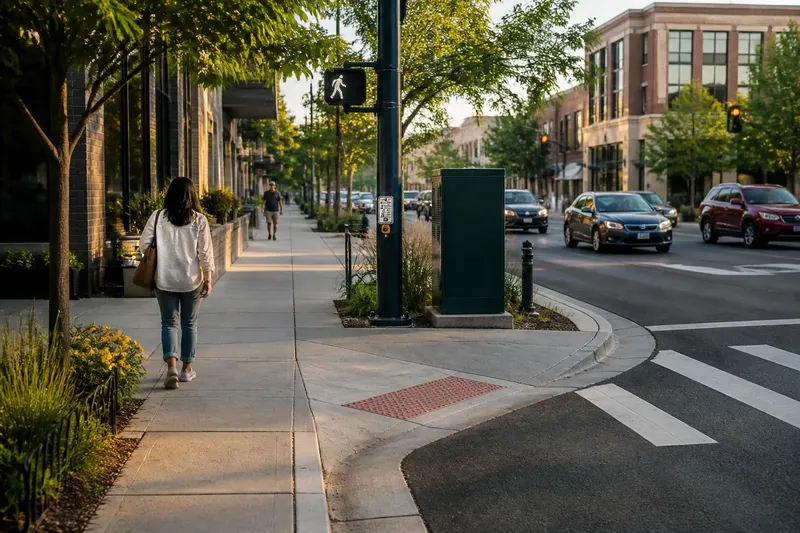
At a busy intersection, the sidewalk seems to run into a driveway apron, a signal pole blocks the curb ramp, and a person arriving on foot has to guess where the crossing begins. A legible street corner makes those choices clearer by connecting the sidewalk, crossing and adjoining routes in a way people can understand from the approach.
What makes a street corner easy to read?
People need cues that connect the place they are standing with the route ahead. A curb, continuous sidewalk surface, building frontage or planting strip can show where the pedestrian route runs and where it changes direction. The parts do not need to look identical from block to block; they do need to make sense together at the junction.
Look from the sidewalk approach, not only at a plan. A drawing may show an open path, while a parked vehicle, utility cabinet or dense planting hides the crossing from someone waiting at the curb. The useful test is whether the route is understandable from the actual places where people pause and choose.
How should a corner distinguish walking space?
A sidewalk needs a recognizable relationship to the roadway, cycle route, loading area and private frontage. A curb or planting strip may mark that relationship, while paving can help show where a crossing or waiting area begins. Like a doormat at a doorway, a clear transition can signal a change of place without requiring a paragraph of explanation.
Too many boundaries can be as confusing as too few. A hedge, opaque fence or advertising panel may separate spaces but also hide people approaching from the other side. An open fence or low planting can define an edge while preserving views; the right choice depends on what needs to be seen at the junction.
Surface changes should reinforce the route rather than suggest a different one. A decorative band that turns before the sidewalk does may look like an invitation into a vehicle entrance. Where curb ramps, tactile surfaces or markings are involved, the design should follow applicable accessibility standards and local requirements.
Does the shortest-looking route work for everyone?
A diagonal line across a corner may appear direct, but it can cross turning movements or leave little room to wait. A person using a wheelchair, someone guiding a child or a pedestrian checking for turning vehicles may need a route that is clearly connected to the curb ramp and crossing, not merely a shorter line on a plan.
Corner geometry also affects vehicle movement and pedestrian visibility. A design that accommodates turning vehicles should still make the crossing and waiting area apparent. The aim is not to erase competing movements, but to show how they meet and where each user should expect to travel or yield.
Say a designer is reviewing an invented neighborhood corner where a side street meets a busy avenue. The starting conditions are a broad driveway-like apron, a curb ramp that appears to point toward the apron, and a crossing partly screened by a utility cabinet. The designer first maps the sidewalk, ramp and crossing as one continuous pedestrian route, then considers shifting the cabinet and distinguishing the crossing surface from the apron. If the revised layout leaves the ramp connected to the crossing and restores a clear view from the approach, the design answers the immediate question; if the cabinet cannot move, the crossing location or other site elements need another review.
What should you check at a street corner?
Use each observation to identify a next decision, rather than treating “confusing” as a complete diagnosis.
- Sidewalk continuity: Check whether the walking surface or its edge carries around the corner. If both disappear, then identify a boundary or surface treatment that can show the route onward; otherwise, keep the existing cues and check the next connection.
- Crossing visibility: Check whether the crossing can be seen from the sidewalk approach. If a vehicle, sign or cabinet blocks it, then review the obstruction’s placement or the crossing’s location; otherwise, check its connection to the curb ramp.
- Curb-ramp direction: Check whether the ramp leads to the crossing rather than a driveway or cycle path. If it points elsewhere, then revise the alignment or clarify the route; otherwise, confirm that the landing and crossing read as connected.
- Turning views: Check whether a driver approaching the turn can see people waiting to cross. If planting or street furniture screens them, then reconsider its placement or form; otherwise, retain the clear view and inspect the crossing from the pedestrian side.
- Overlapping paths: Check where a cycle track, bus stop, loading area or driveway intersects the sidewalk. If the edges disappear at that point, then clarify the transition and expected yielding; otherwise, preserve the distinction already present.
- Lighting at the decision point: Check whether the sidewalk edge, ramp and crossing remain visible after dark. If a route change falls into shadow, then review fixture placement and lighting design; otherwise, check that poles do not obstruct the walking line.
Which street-corner questions come up most often?
How can you tell whether a sidewalk continues?
Look for a continuous walking surface, a curb or frontage line that carries around the turn, and an opening toward the next block. If the paving continues but seems to lead into a vehicle apron, the route may need a clearer boundary or transition.
What helps people recognize a crossing?
The crossing should be visible from the approach and connected to the curb ramp and waiting area. Signs can supplement those cues, but they cannot fix a crossing hidden from view or disconnected from the sidewalk.
Should every corner use the same paving and curb treatment?
Familiar treatments can help people understand a route, but a corner with a cycle track, transit stop or unusual frontage may need a different detail. Whatever the treatment, the pedestrian path should remain distinct and its relationship to other movements should be clear.
When can a direct path be a poor choice?
A direct line may cross turning traffic, remove a waiting area or make the accessible route harder to follow. Compare it with the route people can reach and use, including its connection to the crossing and curb ramp.
What can make a corner harder to use?
Objects placed close together can crowd a crossing even when each has a purpose. A signal pole beside a signpost, a cabinet near the ramp and a tree close to the curb may narrow the walking line or hide someone waiting to cross. Coordinating their placement can be more useful than adding another sign.
Materials can also send mixed signals. Matching paving across a sidewalk and vehicle entrance can blur their difference, while a decorative strip that bends away from the actual path can suggest a route that does not exist. Arrange materials to match the movement they are meant to clarify, and review the result from each approach.
A corner serves people arriving from different directions, so a clear view from the main street is not enough. Check the side-street approach, the crossing and the sidewalk beyond the junction. If one view reveals a conflict that another hides, adjust the design or coordinate the elements responsible for it.
A useful street-corner review ends with a specific next decision: retain a clear route, move an obstruction, clarify a crossing or revisit a ramp connection. That makes legibility practical rather than decorative—and gives the next design conversation something more useful than the word “awkward.”