A First Visit to an Unfamiliar Civic Building
A first visit to an unfamiliar civic building feels simpler when you know what to check at the entrance, how to find public services, and when to ask.
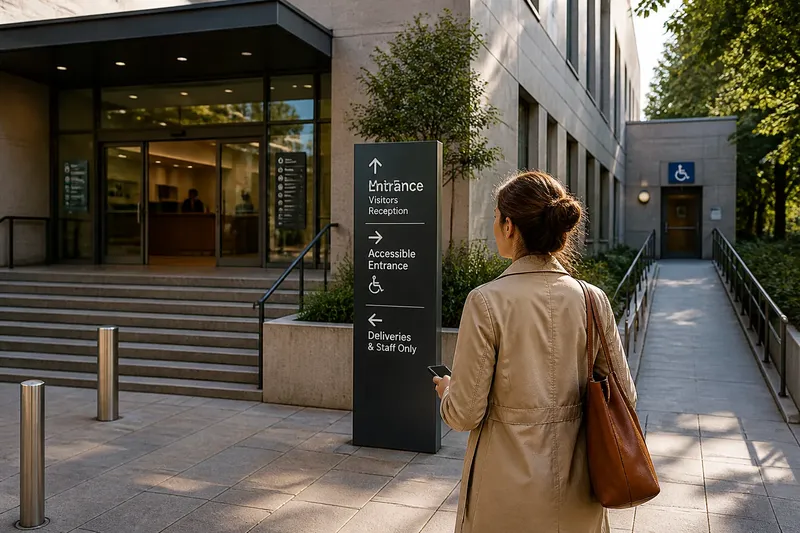
You reach an unfamiliar civic building and see several doors, a broad stair, and a sign that appears to address regular visitors. A first visit to an unfamiliar civic building is easier when you know how to identify the public entrance, find basic information, and ask before crossing an unclear boundary.
The useful question is not only which door is correct. It is what you can confirm from the public approach, and what you should ask rather than guess.
How do you identify the public entrance?
From a place where you can pause without blocking the sidewalk, look for a public sign, a reception area visible through the entrance, or a path that ends at a clearly marked door. A canopy or a prominent doorway may help, but neither proves that the entrance is open to visitors.
Do not assume the largest door is the public one. It may serve deliveries or vehicles, while a smaller door handles ordinary visitors. Follow signs from the sidewalk, plaza, transit stop, or parking area; if the route points to a different door than the one nearest you, use the marked route.
Stay on the public path and avoid inspecting private windows or trying doors with staff-only or delivery notices. If the signs conflict, look for a public-facing desk or posted contact information rather than testing an uncertain entrance.
What should you check before entering?
Read the sign on the door and check whether the approach is open. Notice whether the doorway leads toward a visible lobby, reception counter, or directory. These cues can help you decide whether you have found a visitor entrance, but they cannot confirm current opening arrangements.
Check the threshold for an unobstructed landing and note whether the door is manual or automatic. If the entrance is recessed, move only as far into the public approach as needed to read the sign. A shallow pause is enough; the doorway is not a waiting room for people trying to look decisive.
If you need a step-free route, look for a sign identifying an accessible entrance or a continuous level path to a marked public door. If you cannot identify one from the public route, ask staff or use posted contact information. Do not assume that a nearby service entrance is available to visitors.
Say you arrive from a bus stop and see a prominent stair plus a level path that bends toward a side door. The hypothetical starting point is that you need step-free access and cannot tell whether the side door is public. First, follow the level path without leaving the public route; next, check the door sign for visitor or accessible-entry directions. If it is marked for visitors, you have a clear next door to try; if it is restricted or unclear, stop and ask at a public information point or use posted contact details. The tradeoff is a short pause instead of an uncertain entry.
How do you find the service or room you need?
Once inside, pause where you will not obstruct the entrance. Look for a reception counter, directory, map, or sign naming public services. Start with the cue that identifies the building or service; then follow directions to the destination.
If a map is mounted on a wall, compare its orientation with a visible feature such as the entrance before following an arrow. If a directory names several floors but the stairs or elevator are not apparent, look for another directional sign or ask at reception. A map that requires a small moment of interpretation is still preferable to confidently choosing the wrong corridor.
Use public counters and marked public areas as your guide. An open view into another room does not mean that room is available to visitors, and a controlled door may mark a boundary rather than a shortcut.
What should you do if you are unsure?
Where should you wait for someone?
Choose a designated lobby seating area or another public place that does not obstruct circulation. If there are several entrances, agree on a recognizable feature inside, such as a directory or reception counter.
How do you know whether a door is for visitors?
Check the door’s sign and whether it connects to the marked public route. If it is labeled staff-only, delivery, or restricted, do not enter; choose a marked visitor entrance or ask at a public-facing desk.
What if the accessible entrance is unclear?
Look for posted directions to a step-free entrance and follow them only along the public route. If signs are missing or the route appears to end at a restricted area, ask staff or use the building’s posted contact information.
When should you ask for directions?
Ask when signs disagree, a route ends at a controlled door, or the service you need is not listed clearly. A brief question at reception is better than trying a sequence of doors on a guess.
Which checks help you choose the next move?
- Check the entrance sign: if it identifies a public entrance, use that door; if it marks a restricted or service entrance, return to the public path and find a visitor sign.
- Check whether the approach remains on a public path: if it does, continue to the marked door; if it leads behind a barrier or into a service area, stop and ask for directions.
- Check for step-free access directions: if they lead to a marked public entrance, follow them; if they are absent or unclear, contact staff rather than trying an unmarked side door.
- Check the first visible information point: if reception or a directory names your destination, follow its directions; if not, ask at the desk or look for posted visitor information.
- Check whether the map matches a visible landmark: if its orientation is clear, use its directions; if not, confirm the direction with another sign or a staff member.
- Check any door before crossing it: if it is marked for public use, proceed as directed; if it carries a restriction or no clear sign, choose a marked route or ask.
When should you stop and ask?
Visible signs cannot tell you everything. A public entrance may be closed for an event, or a service counter may have moved. Ask when the building’s directions conflict or when your access needs are not addressed by the posted information.
A first visit to an unfamiliar civic building does not require you to solve its whole layout. Confirm the visitor entrance, use the first public information point, and ask before crossing a boundary that is not clearly open to visitors. That small pause can also tell staff which signs or directions need attention.