From Parade Ground to City Green: Why Parks Took Root
Why parks took root becomes clearer through their civic and social histories: see how promenades, commons, and urban pressures shaped public leisure.
Why parks took root is a question about land, access, and leisure, not just trees. In London, the royal parks began as spaces tied to the Crown; later public access changed how many people could use them. That history points to a larger pattern: urban parks took shape through distinct local decisions, not one shared origin story.
Why did cities set land aside for parks?
Different kinds of open space had different beginnings. A common was land used under local customs; a royal park served the monarch’s purposes before access broadened; a promenade offered a deliberate route for walking and being seen. These forms could overlap, but they were not interchangeable, and calling each one a park can blur who controlled the land.
London’s Hyde Park illustrates the change in purpose and access without standing for every city. It originated as a royal hunting ground and later became a public space for recreation and gatherings. The shift was not simply a matter of adding paths or planting trees: it involved changing who could enter and what kinds of use the grounds accommodated.
Other cities followed different routes. New York’s Central Park was planned as a large public landscape rather than adapted from a royal estate, while Boston Common had long functioned as shared civic ground. Those histories make clear that parks could be created, reshaped, or inherited from earlier uses. Their common feature was not a single design, but the claim that open ground should serve public life.
How did changing ideas of leisure shape parks?
As urban neighborhoods grew denser, open ground near home could be scarce. Park advocates argued for places to walk, sit, exercise, and spend time outdoors without making a purchase. Those aims answered practical needs, but they also reflected ideas about which pastimes were respectable and how visitors ought to behave.
Promenades, ornamental gardens, and broad lawns often favored strolling and quiet recreation. Other spaces made room for games and organized sport. A park designed mainly for one kind of leisure could leave little room for another: a field for active play might not suit someone seeking quiet, while strict rules for quiet use could make children’s games unwelcome.
Access also depended on rules, custom, and public authority. The word “public” did not itself settle who felt welcome or what visitors were allowed to do. Park histories therefore include both expanded access and disputes over conduct, ownership, and the uses that counted as proper recreation.
How could a ceremonial ground become a useful park?
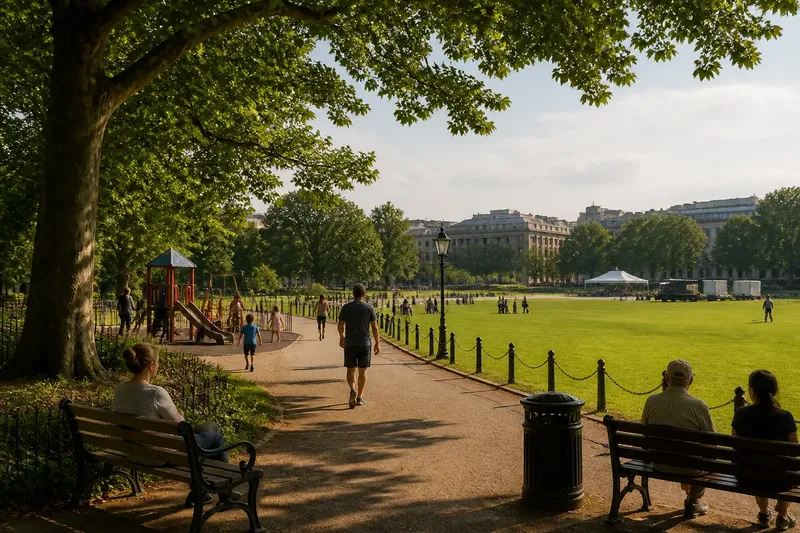
Imagine a city considering a former parade ground beside a growing neighborhood. Its central field still hosts civic gatherings, but on ordinary days it offers few reasons to stay. The city keeps the center open, adds a continuous walking path along the edge, places benches beneath shade trees, and locates a small play area near a visible entrance. Event crews receive a layout that keeps the path and play area clear during setup.
Those choices produce observable differences. A visitor can cross the site on the marked route while the center is being prepared; a caregiver can see the play area from the entrance-side benches; and the open field remains available for a gathering rather than being divided into permanent facilities. The tradeoff is that the field cannot host every activity at once, so event plans need to preserve ordinary passage.
Like a shared table with a clear aisle, the park can accommodate people doing different things without asking them to occupy the same spot. The analogy is modest, which is appropriate: paths and edges do not resolve every conflict, but they can make routine use easier to read.
What questions clarify a park’s history?
Were early parks always open to everyone?
No. Land could be privately or royally controlled before access changed, and public rules could still limit how people used it. The history of a park depends on who held authority and how entry and conduct were regulated.
Why did promenades matter?
A promenade gave visitors a route for walking and social display, making movement itself part of the park’s use. Its ordered design could invite leisure while favoring a narrower idea of acceptable behavior than an open field might.
Did parks all begin as military or royal grounds?
No. Some adapted earlier grounds, while others were planned or grew from common land and different civic uses. Treating one origin as universal hides the decisions particular to each place.
What can a park’s rules reveal?
Rules show which activities authorities permit, manage, or discourage, from games to public gatherings. Comparing written rules with the spaces provided for those activities helps explain whose leisure the design supports.
What should visitors notice in a park?
On an ordinary visit, look for a few concrete signs of how the space serves the public:
- If a path stays open during events, then it supports everyday passage; if it closes, look for a clearly marked alternative route.
- If benches face both a play area and a path, then visitors can sit while keeping those activities in view; if they face only a scenic feature, seating may serve a narrower purpose.
- If posted rules name permitted activities, then visitors have a clearer basis for deciding what to do; if rules are vague, check for signs or staff guidance before starting a disputed activity.
- If open grass remains beside built facilities, then the park preserves room for unplanned use; if nearly all ground is assigned, expect activities to depend more on designated areas.
- If entrances connect to neighborhood sidewalks, then walking into the park is straightforward; if access points are limited, use the signed entrance rather than crossing closed boundaries.
- If event notices explain which areas remain available, then visitors can plan around closures; if notices omit that detail, ask park staff which routes and facilities stay open.
These observations do not settle whether a park is fair or successful. They do show how a city has turned ideas about leisure into paths, fields, rules, and access. Why parks took root varied from place to place, but a useful final clue is the unremarkable visit: who can enter, what they can do, and whether ordinary use survives when the calendar brings a ceremony.